


TL;DR
A DUPRO (During Production Inspection) saves you significant time and money by identifying and correcting product defects early in the manufacturing process. This proactive quality control check, typically performed when 10-20% of goods are produced, prevents minor issues from escalating into widespread problems. By catching errors mid-production, you avoid costly large-scale rework, minimize material waste, and ensure your project stays on schedule.
What is a DUPRO (During Production Inspection)?
A During Production Inspection, commonly known as DUPRO, is a critical quality control checkpoint that occurs while your goods are actively being manufactured. Unlike other inspections that happen before or after production, a DUPRO is strategically timed to take place once a certain percentage of your order is complete—typically between 10% and 50%. This allows inspectors to assess both semi-finished and finished units directly from the production line.
The primary purpose of a DUPRO is to provide a real-time assessment of the manufacturing process. It answers crucial questions: Are the products being made according to the correct specifications? Is the quality of materials consistent with the approved samples? Is the factory on track to meet the delivery deadline? By intervening mid-process, you gain the visibility needed to confirm that production is proceeding as planned and that quality standards are being met from the start.
To better understand its role, it’s helpful to see how DUPRO fits within the broader quality control framework. A Pre-Production Inspection (PPI) verifies raw materials before manufacturing begins, while a Pre-Shipment Inspection (PSI) or Final Random Inspection (FRI) evaluates the final goods before they are shipped. DUPRO acts as the essential bridge between these two stages, offering a unique opportunity to make corrections before it’s too late and too costly.
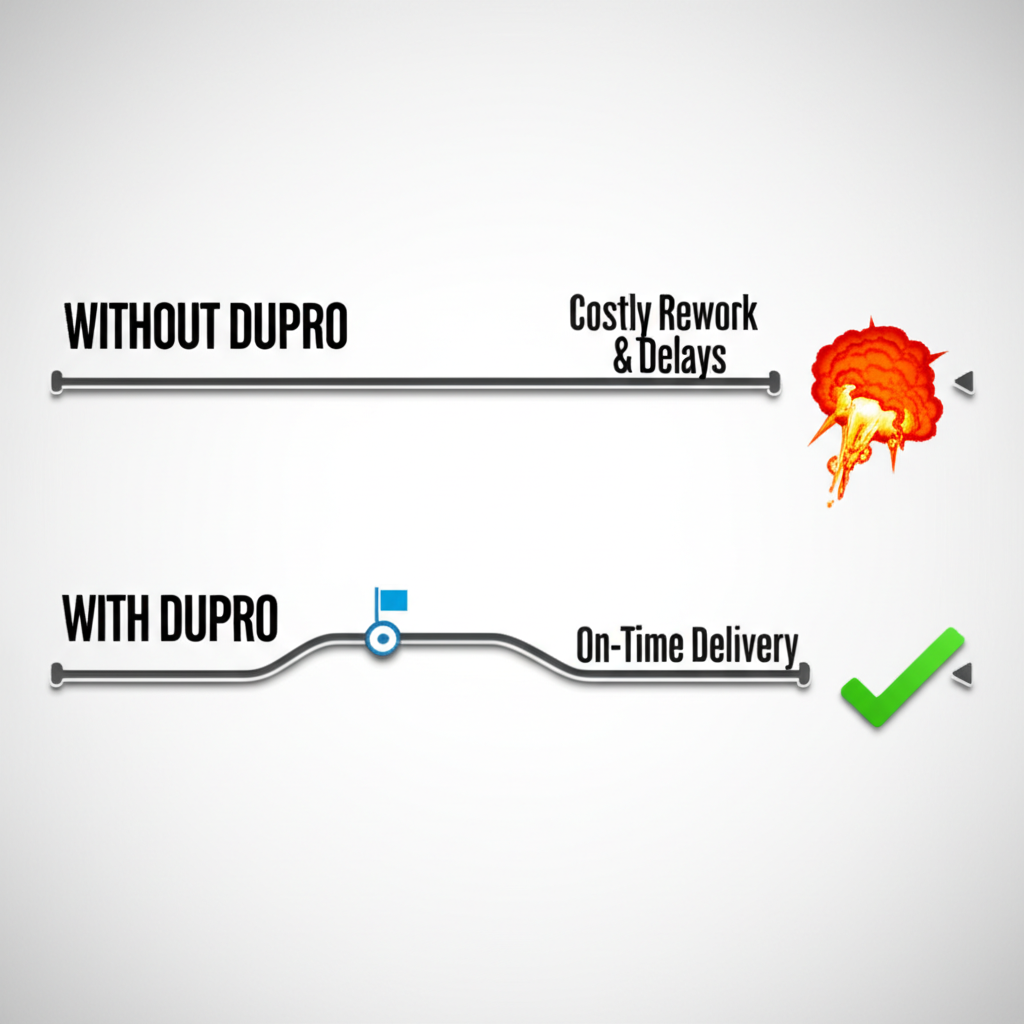
How DUPRO Directly Saves Time and Reduces Rework Costs
The core value of a DUPRO lies in its ability to deliver substantial time and cost savings by tackling problems proactively. Instead of discovering a catastrophic issue in a fully completed order, you can identify and resolve it when it’s still a small, manageable problem. This approach prevents the financial and logistical headaches associated with widespread defects.
A DUPRO achieves these savings through several key mechanisms:
- Early Defect Detection: The most significant benefit is catching defects early. An issue identified when only 15% of an order is complete can be corrected with minimal impact. According to Testcoo, if major quality issues are only found at the final stage, the entire batch may need rework or rejection. A DUPRO transforms a potentially massive problem into a minor adjustment.
- Minimizing Material Waste: When defects are found mid-production, only a small portion of raw materials has been used. Correcting the issue prevents the remaining materials from being wasted on faulty products. As noted by Amrep Inspect, this helps manufacturers avoid unnecessary waste and save on material costs.
- Avoiding Costly Large-Scale Rework: Reworking finished products is expensive, involving additional labor, time, and sometimes even shipping costs to fix the items. By addressing problems on the production line, rework can be integrated into the normal manufacturing flow, drastically reducing its associated costs and complexity.
- Preventing Production Delays: Quality issues discovered at the final inspection stage can cause significant shipping delays as the factory scrambles to fix or remake the order. A DUPRO allows for on-the-spot corrections, helping to keep the production schedule on track and ensuring on-time delivery.
The DUPRO Process: What an Inspector Actually Checks
During a DUPRO, a quality control inspector visits the factory to perform a systematic evaluation of the production process and the products themselves. The goal is to get a comprehensive snapshot of quality, consistency, and adherence to specifications. The inspector doesn’t just look at finished goods; they assess the entire production environment to identify root causes of potential issues.
A typical DUPRO checklist includes several key areas of focus:
- Verification of Raw Materials and Components: The inspector confirms that the materials being used are the same as those approved in the pre-production stage. This prevents unauthorized substitutions with cheaper or lower-quality alternatives.
- Inspection of Semi-Finished and Finished Goods: Using a statistical sampling method like AQL (Acceptable Quality Limit), the inspector pulls random units from the production line. These samples are checked against the product specification sheet for dimensions, functionality, color, and overall workmanship.
- Production Line Assessment: The inspector observes the manufacturing and assembly lines to ensure processes are being followed correctly and consistently. This can reveal issues with machinery calibration, worker training, or internal quality control procedures.
- Packaging and Labeling Review: Early samples of packaging, labels, and barcodes are checked for accuracy to ensure they meet all requirements. Finding a labeling error at this stage is far easier to fix than relabeling thousands of units later.
Upon completion, the inspector provides a detailed report with photos and a summary of all findings. This report categorizes defects as minor, major, or critical, giving you a clear understanding of any issues and allowing you to instruct the factory on corrective actions. For businesses sourcing internationally, having a trusted partner on the ground is invaluable. Companies like China Quality Inspection offer a full range of services, from factory audits to inspections, acting as your eyes in the factory to ensure products meet exact specifications. You can explore our full range of quality control services to secure your supply chain.
When is a DUPRO Most Essential for Your Production?
While a DUPRO is beneficial for nearly any manufacturing run, there are specific scenarios where it becomes absolutely critical for mitigating risk and ensuring a successful outcome. In these situations, the potential cost of not performing an in-process inspection far outweighs the cost of the inspection itself. Forgoing a DUPRO in these high-stakes contexts can expose a business to severe financial loss, reputational damage, and supply chain disruptions.
Consider implementing a DUPRO as a non-negotiable step in the following situations:
- Working with a New Supplier: When you’re partnering with a factory for the first time, you have no prior history to rely on. A DUPRO serves as a crucial verification step to ensure they understand your quality standards and can execute them properly before the entire order is completed.
- Manufacturing Complex or High-Value Products: For products with intricate components, strict technical specifications, or high unit value (such as electronics or medical devices), the cost of defects is extremely high. An early inspection is essential to verify functionality and compliance.
- Large Volume Production Runs: The larger the order, the greater the financial risk. A small defect rate on a massive order can still result in thousands of faulty units. A DUPRO helps ensure consistency across the entire production run and prevents a minor issue from scaling into a major disaster.
- When Product Quality is a Key Brand Differentiator: If your brand’s reputation is built on premium quality and reliability, you cannot afford to ship substandard products. A DUPRO is a vital tool for upholding brand standards and ensuring customer satisfaction.
In each of these cases, a DUPRO acts as a strategic insurance policy. It provides the oversight needed to protect your investment, maintain your production schedule, and deliver a final product that meets both your and your customers’ expectations.

