Key Inspection Points for Baby Rompers
These points are categorized based on when they occur in the production process.
1. Pre-Production & Material Inspection
This stage ensures the raw materials meet safety and quality standards before manufacturing begins.
Fabric Quality: Check fabric weight (GSM), fiber content (e.g., 100% cotton), and for any visible flaws like stains, holes, or dye inconsistencies using a 4-point inspection system .
Color Fastness: Test fabric for color fastness to saliva, perspiration, washing, and rubbing to ensure dyes do not bleed or irritate a baby’s skin .
Chemical Compliance: Verify that the fabric meets regulatory standards for formaldehyde, pH levels, and prohibited azo dyes .
Trim Inspection: Ensure all accessories (snaps, zippers, labels) are free from sharp edges, are nickel-free, and meet safety standards like OEKO-TEX .
2. In-Production & Stitching Quality
This focuses on the construction and durability of the garment.
Seam Strength: Check that seams (especially at shoulders, crotch, and armholes) are secure and can withstand tension. Flatlock or overlock seams are preferred to prevent skin irritation .
Stitch Density: Measure stitches per inch (SPI) to ensure consistency and prevent seams from unraveling .
Workmanship: Inspect for loose threads, skipped stitches, and ensure that all stitching lines are straight and even. Pay special attention to areas around the neck and crotch .
3. Safety and Attachment Security
This is the most critical area for infant products to prevent choking or injury.
Attachment Pull Force: Test the security of buttons, snaps, and appliqués using a tension gauge to ensure they cannot be easily pulled off and swallowed .
Sharp Points/Edges: Inspect all metal or plastic accessories to ensure there are no sharp points or edges that could cut a baby .
Needle Detection: Pass every finished garment through a metal/needle detector to ensure no broken needles or pins are left in the product .
4. Sizing and Labeling
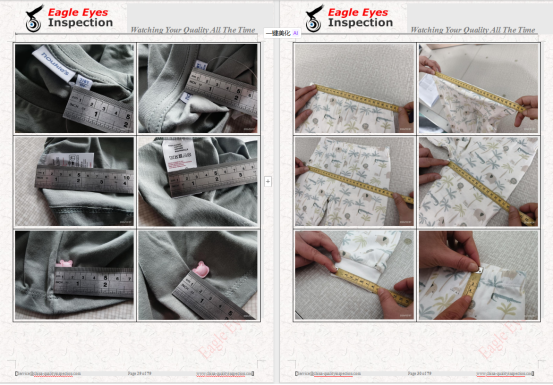
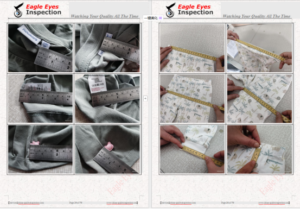
Dimensional Accuracy: Measure the garment against the tech pack specifications. Tolerances for babywear are very tight (often ±0.5cm) to ensure a proper fit .
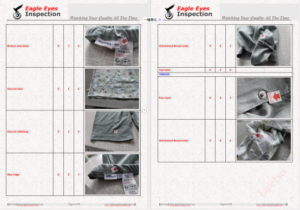
Label Placement: Ensure that care labels and size labels are sewn in locations that will not irritate the skin (usually on the outside or in a flat seam) .
Label Information: Verify that the label content (fiber content, care instructions, size, and safety certification) is correct and legible .
5. Final Inspection (Out-of-Box)
Appearance: Check for overall cleanliness, ironing quality, and the absence of stains or odors .
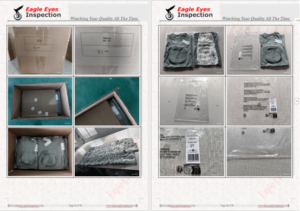
Packaging: Ensure the product is folded correctly and packed with the correct hang tags, barcodes, and poly bags as per client instructions .
Standard Inspection Steps (AQL Procedure)
A typical inspection follows these sequential steps:
Preparation: Obtain the approved sample (the “Golden Sample”) and the Inspection Report from the client to use as a reference .
Sampling: Select a random sample of cartons and garments according to the AQL (Acceptable Quality Limit) standard (e.g., AQL 1.5/2.5) .
Visual & Manual Check:
Compare the product to the reference sample for color and style .
Check all stitching, seams, and fabric as described in Sections 1 and 2 above.
Verify all accessories and attachments as described in Section 3.
Measurement Check: Measure the critical dimensions of the sample (chest, length, sleeve length, rise) against the size chart .
Functional Test: Snap and unsnap all fasteners to ensure they function correctly. Stretch the garment gently to check seam recovery .
Needle Scan: Pass all garments through a needle detector machine .
Documentation Review: Review the packing list, carton quantity, and shipping marks. Compile the final QC report with photos and results .